The genus Dracaena includes between 60 and 100 species. It belongs to the family of Asparagaceae or Dracaenaceae. Dracaena species are exceptional among monocotyledonous plants due to their ability for secondary growth of stems, branches, and roots. Most Dracaena species grow as shrubs or geophytes. There are only eight species with tree growth, and the xeromorphic Dracaena cinnabari is among them.
The Dragon Blood Tree is considered a unique, special, and magical tree. Traditionally, it has held a magical and religious place in the lives of, for example, the indigenous people of the Canary Islands where the Dracaena Draco species occurs. The resin has a deep red color that is also associated with witchcraft.
In addition to its religious and magical significance, the 'dragon tree' is also essential for the medical world. The dragon blood tree contains substances that can be used in the fight against cancer. For example, consider cytostatics against leukemia. In particular, icogenin is cytotoxic in myeloid leukemia. But other substances from the 'dragon tree' are also being researched for their effects against cancer. In short, the Dragon Blood Tree is magical, special, and unique; a real piece of Art!

The Canary Dragon Blood Tree of Tenerife (Dracaena Draco or el Drago Milenario) makes an impression worldwide in gardens with a Mediterranean climate. Its heavy limbs grow at impossible angles and slopes. With its umbrella-shaped crown of about 9 meters in diameter and its sausage-like branches, it defies gravity.
The dragon blood tree, also known as el Drago Milenario (thousand-year-old dragon blood tree), is the emblem of Tenerife and an important attraction for many tourists. If you want to know more about Tenerife, you can read the book by Guy Devos as a reference work with a lot of useful information about everything and anything in Tenerife.
Pieter van de Borcht created a meticulously detailed watercolor of the Draco at the end of the 16th century. The Dracaena Draco, the most famous of which is located in Tenerife, was among the plant/tree species that attracted the most interest from explorers, historians, travelers, and natural scientists, along with the Canary Island pine, the Garoé (the sacred tree and icon of El Hierro), and the Orchilla (a lichen from which red dye was extracted).
Although there are images of the Dragon's Blood Tree (such as those by Martin Schongauer from 1475) predating the time of v.d. Borcht, this one by Pieter van de Borcht is considered the first accurate botanical description of the Drago Macaronesico. Alexander von Humboldt (1769-1859) was also fascinated by the island of Tenerife and the dragon's blood tree.
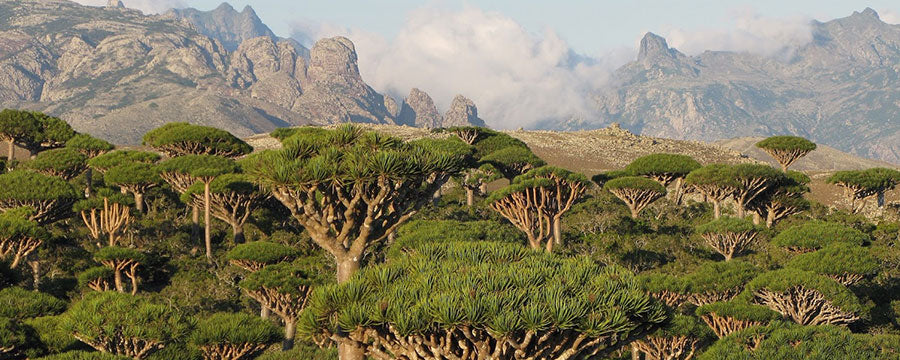
The Dracaena Cinnabari is a large dragon's blood tree with a single trunk reaching up to 10 m in height and smooth gray bark. Branches with sausage-shaped sections form an umbrella-shaped crown. The crown shape is adapted to dry climates and is influenced by the availability of humidity. Sturdy leaves are densely tufted, dark green, and elongated, up to 60 cm long and up to 4 cm wide. The leaves are spiky and firmly shaped, which is a characteristic feature of the tree to prevent excessive water loss.
Small creamy flowers grow in large terminal clusters. Spherical fruits have a diameter of about 1 cm and contain 1 to 3 spherical and brownish-red seeds, which are very hard. Their ripening stage goes from black to red. The seeds are dispersed by birds. Since ancient times, the plant has been used for harvesting blood-red medicinal resin and as firewood. Additionally, flowers, fruit, and leaves are used as a source of dry fodder for livestock.
The Dracaena Cinnabari (Dragon's Blood Tree) is an endemic species and the most iconic plant of the island of Socotra. It is a very striking and beautiful tree in the landscape of Socotra, particularly at altitudes between about 300 and 1480 m. Socotra is an isolated island located in the Indian Ocean between the Horn of Africa and the Arabian Peninsula. It belongs to the Republic of Yemen. The island is one of the most biodiverse islands in the world.
The unique vegetation adapted to a semi-arid environment is a evergreen forest dominated by the Dragon's Blood Tree (Dracaena Cinnabari). The flagship of the Socotra species Dracaena Cinnabari suffers from a lack of regeneration due to intensive grazing by goats. Therefore, seedlings and young trees mainly grow on rocky ridges and other locations that are inaccessible to goats. Only mature and overripe trees are found in accessible areas. The Dracaena forest on Firmihin is considered one of the oldest forest communities on Earth. However, the further development of this tree community is not optimistic.
The vulnerable Dragon Blood Tree has therefore been one of the main focal points for conservation efforts and research activities in Socotra in recent years.

The Dragon Blood Tree of Gran Canaria (Dracaena Tamaranae) is a species that grows in the mid-mountains in the southwestern quadrant of the island of Gran Canaria: from the rock walls of Amurga in the Fataga ravine to the heights of Junquillo in the La Aldea ravine. In the 1960s, groups of climbers located a few wild individuals of the Dragon Blood Tree in the ravines of the southern part of the island. These findings were reported to Gunther Kunkel, the German natural scientist and botanist, who published the discoveries in 1972 and 1973. In Kunkel's descriptions, as well as in other contributions about locations and mapping them, the species is referred to as the Macaronesian Draco or the Drago of Gran Canaria.
It occurs exclusively on inhospitable mountain slopes and ravines and is described as characteristic of vegetation that thrives in a thermo-dried environment in tropical/subtropical areas.
The Dragon Blood Tree is relatively “drought-loving”: that is to say: it thrives in zones with 200 to 500 mm of rainfall per year. But… the last living wild specimen that grew on the steep northern slopes unfortunately did not survive the drought and ultimately died in 2009. The species is now only seen in cultivated conditions.

The Dracaena Serrulata species (also known as the Dragon Blood Tree of Arabia - Yemen) is described by Joh Gilbert Baker in 1894. This British botanist spent a large part of his life mapping and documenting various groups of vegetation including bromeliads, amaryllids, and many others. He describes no less than 68 species and subspecies of Dragon Blood Trees.
Baker writes about the Serrulata: “Dragon blood trees have been both the source of legends from ancient times and for the exploitation of the resinous saps, known as dragon's blood. This is a very valuable substance that has been (and is) used for various applications: from balm liquid to wood preservation, including wood that was used to build Stradivarius violins.
The Canary Draco makes an impression worldwide in gardens with a Mediterranean climate. The similar “Arabian Serrulata” is rarely found in cultivated conditions but is equally valuable. The difference lies in the narrow, stiff, sea-green leaf and the slower growth.
The stiff leaves of the Dracaena serrulata were an important source of fibers and rope. The large, stiff, pointed leaves were cut or pulled from the trunk. They were beaten with heavy clubs to loosen and break open the stiff outer sheath of the leaf. The leaves were then soaked in water for several weeks. After they were thoroughly softened, the leaves were removed from the water and stacked in piles on a hard flat surface. They were then beaten for a long time to separate the fibers into individual strands. Once the individual fibers were unraveled, they were twisted and rubbed against the thigh to produce threads. These threads were traditionally said to be the strongest of all the rope produced in Oman.
The rope made from the Dracaena serrulata was used as camel tackle, luggage ropes, and rope pulleys. They were used to lower heavy bags of incense, for example, in areas where luggage camels had difficulty penetrating. Ropes from this plant were also used to make harnesses in which men were lowered from steep rock faces to collect wild honey.
The fibers of the Dracaena serrulata also had a certain 'strength', making them popular for use in slingshots and bowstrings.
The heart of a cluster of leaves from the Dracaena serrulata could also be eaten.
Finally, the wood of the Dracaena serrulata was also occasionally used to make drums. Parts of the trunk were cut horizontally and hollowed out to create the drum, the wooden sides were pierced with small holes, and the top and bottom percussion parts were usually made from goat skin.

The Dracaena Schizantha (also known as the Dragon Blood Tree of Somalia) is found scattered over and along the mountain slopes of northern Somalia above the coast of the Indian Ocean, penetrating into Ethiopia and Djibouti. There, it is sometimes confused with the Nubian species. Some researchers believe it is a subspecies of the Dracaena Ombet, and likely the species are closely related in a few areas.

The Dracaena Ombet (Dragon's Blood tree of Nubia) species is currently known from the foothills of Jebel Elba in Egypt to Djibouti (e.g., in the south of Ghoubbet and Hemed) with a few impoverished populations in Erkowit, above Suwakin and Port Sudan. The tree is locally known as “Ombet” (mother of the Earth) or “asa-ara” or “arob.” Additionally, the species is found in Eritrea and Ethiopia, with populations following the mountains and slopes of the Red Sea.
Dracaena ombet is an evergreen tree with a thick, forked trunk that can reach up to 9 meters in height.
The tree is harvested in the wild for its edible fruit, which is used locally. It is also the source of a resin used in traditional medicine.
Once a widespread and abundant species, overgrazing, overcutting, drought, and possibly an attack by parasitic pests or diseases have contributed to a severe decline in the population. The tree is classified as 'Endangered' in the IUCN Red List of Threatened Species (2010).

Dracaena jayniana is part of a group of species related to the dragon tree Dracaena Draco from the Canary Islands. Dracaena jayniana is limited to central and northeastern Thailand. It is found on limestone karsts at 300-500 m above sea level, usually on hilltops rather than on steep cliffs.
The inaccessible nature of this landscape, combined with the lack of soil and low water availability, has helped protect it from agricultural development. It contains many rare and unusual species that are often restricted to karst limestone.
Dracaena jayniana is considered endangered according to the IUCN Red List criteria (preliminary assessment). It is restricted to isolated limestone karst outcrops, resulting in a fragmented distribution. It grows slowly and has poor seed set (compared to other Dracaena tree species).
Mature plants are harvested from the wild for use in horticulture. However, Dracaena jayniana is less popular than other Dracaena species, and several populations are located near temples, which offers them some protection. The Dragon's Blood tree is collected by locals who believe it brings good luck.
In Thailand, many limestone habitats are threatened by extraction for concrete production, especially those closest to cities like Bangkok.
Dracaena jayniana has woody stems up to 8 m tall, branching at the base, usually with 3-5 upright stems in a cluster. The stems bear leaf scars from the base to the top. The bark is pale brown to gray-brown with vertical splits towards the base, peeling off on either side of the split. This species also exudes dark red sap (dragon's blood or resin) from damaged bark.
This species has extremely long, woody roots that can reach down to the groundwater level beneath the dry, rocky limestone habitat.
Its leaves are tough, leathery, pale green to white, in dense clusters at the ends of the stems. Leaf blades are dark green, up to 75 cm long and 1.3 cm wide. All leaves, except the youngest, are bent near the base.
The flowers of the Dracaena jayniana are dull golden yellow and tepals (undifferentiated petals and sepals). The flowering is upright to ascending inflorescences with four branches.
After flowering, a berry is produced with up to three seeds, glossy olive green when immature, likely dull red when mature (reddish-black when dried), about 1 cm in diameter.
The Dracaena jayniana is known for a number of uses in Thailand. A tonic drink is made from the dried red sap. The plant is also used as an ornamental plant.

The dragon tree species Dracaena Kaweesakii, discovered in 2013 in Thailand, is characterized by its extensive branching. The new species reaches an impressive height of up to 12 meters. The crown diameter can also easily reach 12 meters. The Dracaena Kaweesakii has beautiful soft sword-shaped leaves with white edges and cream-colored flowers with bright orange filaments, all very distinctive features. The study describing this exciting new species was published by an international team of scientists in the open access journal Phytokeys.
The Dracaena Kaweesakii is a relative of the beautiful dragon blood tree from the Canary Island of Tenerife (the dracaena draco). It is an ecologically important species that occurs only on limestone hills and mountains often associated with Buddhist temples in Thailand.
The Dracaena Kaweesakii is harvested from the wild for use in horticulture in Thailand and is one of the more popular species due to its extensive branching. The Thai people believe that dragon blood tree species, in general, bring good luck to households, hence their popularity. Some populations of the Dracaena Kaweesakii are protected by their proximity to temples or have been transplanted into their gardens. There is currently no direct evidence of over-extraction, but sustainability studies are needed at the population level to ensure the protection of this beautiful species. Unfortunately, the Dracaena Kaweesakii is also threatened by limited distribution, limestone destruction for concrete, and tree harvesting for gardens.
Comments will be approved before showing up.

The Ensete ventricosum ‘Maurelii’ is a fast grower with a tropical look that prefers a warm, bright, and sheltered spot. In this blog, you’ll learn how to care for this red banana plant, what to expect each season, and how to keep it healthy from a young plant to a large eye-catcher.

The Musa velutina, also known as the pink banana plant, is a tropical plant that stands out due to its unique appearance and rapid growth with proper care. In this blog, you will learn how to keep it healthy with the right location, watering, potting soil, and nutrition. Additionally, you will discover what to expect throughout the year, from active growth in spring and summer to a quieter phase in autumn and winter. Repotting, leaf care, winter care, and the development from a young plant to a larger Musa velutina are also covered.

Succulents are hardy, stylish, and surprisingly easy – as long as you care for them properly. In this blog, you’ll discover the 10 most frequently asked questions about succulents, from watering and light to feeding and winter dormancy. You’ll learn why less is more, how to prevent overwatering, and which succulents are perfect for both beginners and collectors. Ideal for anyone who wants to keep their succulent healthy without stress or guesswork.