



Difficulty
Average
Requires some attention, but remains manageable.


€3,29 €4,05
| /









With the grow tray for perfect humidity, an LED light playing little sunshine, Nitrozyme for a germination boost and super-hygienic coconut fibres, your seeds grow faster than your excuses for skipping a workout!
The key features, without any botanical detective work.
Difficulty
Average
Requires some attention, but remains manageable.
Rarity
Vulnerable
A species under pressure in its natural habitat.
Germination time
6–14 weeks
The usual time until the first seedling appears.
Germination temperature
25–32 °C
The ideal temperature range during germination.
The name Hyophorbe comes from Greek: hys, hyos meaning pig and phorbe meaning feed. This refers to the fact that in the past, the fruits were used as pig feed. Lagenicaulis means with the stem in the shape of a bottle.
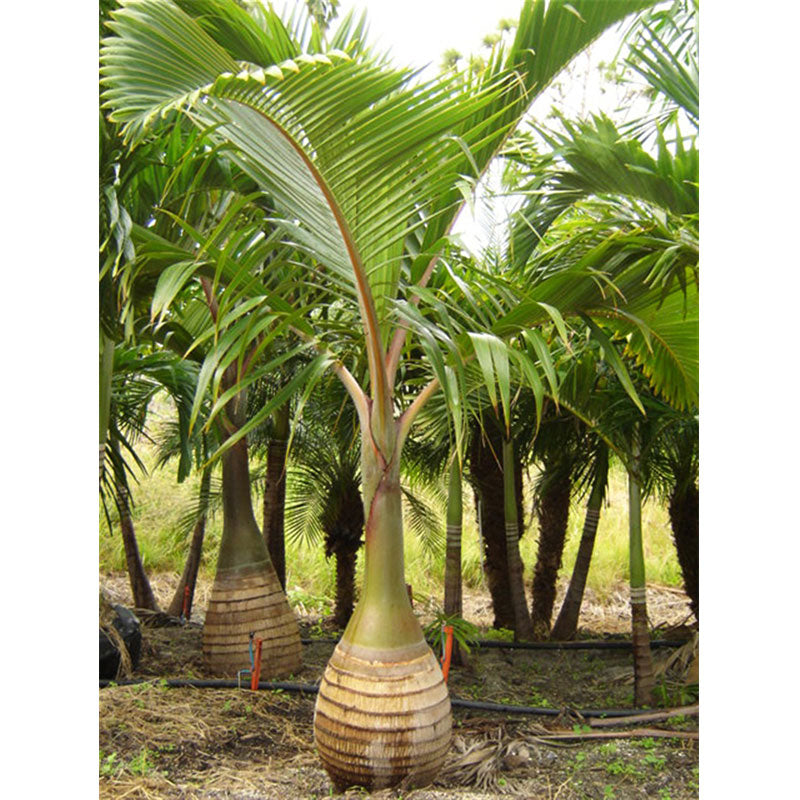
Hyophorbe lagenicaulis, or the bottle palm, is a small palm from the Arecaceae family. This palm remains small and is resistant to the salty air of the coast and cyclones. The Hyophorbe lagenicaulis has completely disappeared from Round Island because goats and rabbits have eaten them, but it is widely cultivated.
The pseudostem is very short and swollen, and the root system is well spread horizontally, providing good protection against cyclones. The leaves are feathery, curved, and stiff, with many leaflets. They appear in clusters of 4-8 at the top of the trunk. They can grow up to 3-4 meters long.
Keep the temperature preferably at a minimum of 13 °C and ensure plenty of light. The palm can tolerate 0 °C, but the leaves may get damaged. The Hyophorbe lagenicaulis can be grown in a small pot. Unlike many other palm trees that have a deep taproot, the Hyophorbe lagenicaulis has a horizontally spreading and shallow root system.
It is quite drought-resistant and prefers well-draining sandy soil. Provide monthly feeding. It can tolerate full sun (but make sure to give enough water), but it prefers a bright location or partial shade.
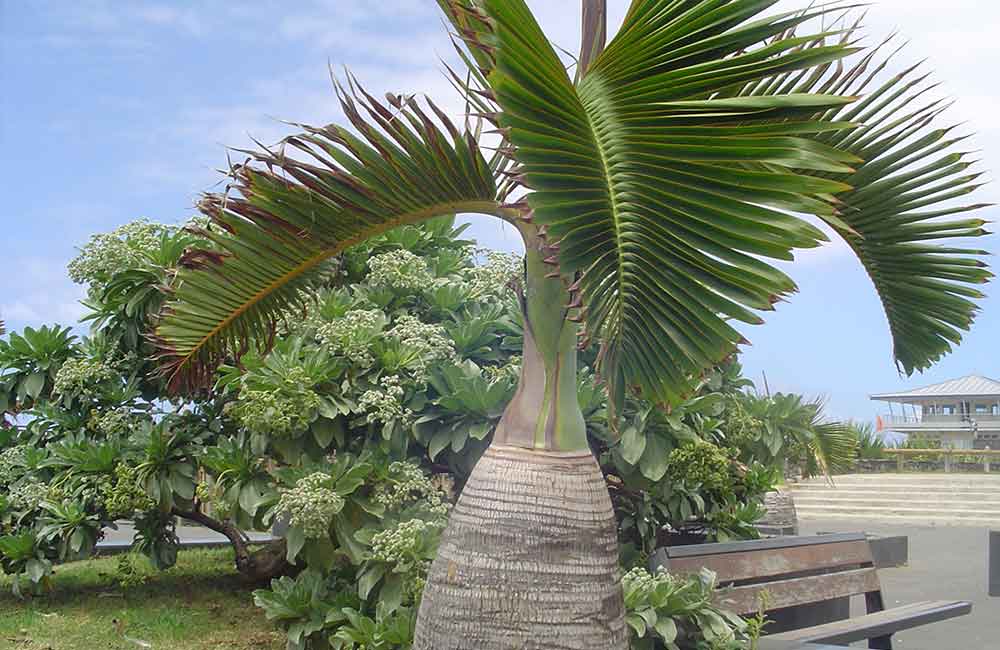
The Hyophorbe lagenicaulis, commonly known as the Bottle Palm, is a unique and visually striking plant that originates from the Mascarene Islands in the Indian Ocean. This small to medium-sized palm species is a favorite among garden enthusiasts and interior designers due to its distinctive shape and tropical appearance.
The most remarkable characteristic of the Bottle Palm is its swollen, bottle-shaped trunk. This unique shape occurs because the trunk is wider at the base and narrows towards the top. The trunk is often grayish and has ring-like scars from fallen leaves. The crown consists of a compact bundle of glossy, feathery leaves that form a lush green canopy.
Naturally, the Hyophorbe lagenicaulis grows in humid, tropical climates. Unfortunately, this species is nearly extinct in the wild, making cultivation in gardens and greenhouses essential for its preservation.
Water: The Bottle Palm requires regular watering but is sensitive to overwatering. Ensure well-draining soil to prevent root rot.
Light: This palm prefers full sun to partial shade. As a houseplant, it needs bright, indirect light.
Temperature: The Hyophorbe lagenicaulis loves warmth and does not tolerate cold well. Temperatures below 10 degrees Celsius can be harmful.
Soil: A well-draining, humus-rich potting mix is ideal for this palm.
Due to its unique shape and compact size, the Bottle Palm is excellent for smaller gardens or as a solitary plant in larger landscapes. It is also ideal as a potted plant for patios, balconies, and as a decorative indoor plant. Its exotic appearance makes it a popular choice for creating a tropical atmosphere.
The Hyophorbe lagenicaulis, with its striking bottle-shaped trunk and lush leaf crown, is a beautiful addition to any tropical or subtropical garden or interior. Not only does this palm provide aesthetic value, but it also represents a piece of conservation, given its rarity in the wild. With the right care and attention, this palm species can be a source of beauty and interest for many years.


&media=https://drakenbloedboom.com/cdn/shop/files/bottle-pam-in-serre_600x.jpg?v=1771360358)